Society of the Cincinnati
After the war, Isaac became one of the original members of Virginia’s Society of the Cincinnati. Henry Knox organized the Society in 1783. He had been George Washington’s chief of artillery and became commander of the American army when Washington retired.
The Society was both fraternal and charitable, assisting officers who fell on hard times. Membership was open to officers serving at the end of the Revolutionary War or those who had served for at least three years. Isaac’s pension application indicated that he served until the war ended.
After his discharge from the Continental Army, Governor Patrick Henry appointed Isaac Major of the Frederick County militia in 1785. In peacetime, militia rank was largely honorary, but Isaac was known as “Major” for the rest of his life. Beginning in 1831, he received an annual military pension of $530. After his death, Ann applied for the difference between that amount and the $578 she believed he was entitled to because of his service as Muhlenberg’s aide. Isaac also received land warrants for property in southern Ohio in recognition of his military service.
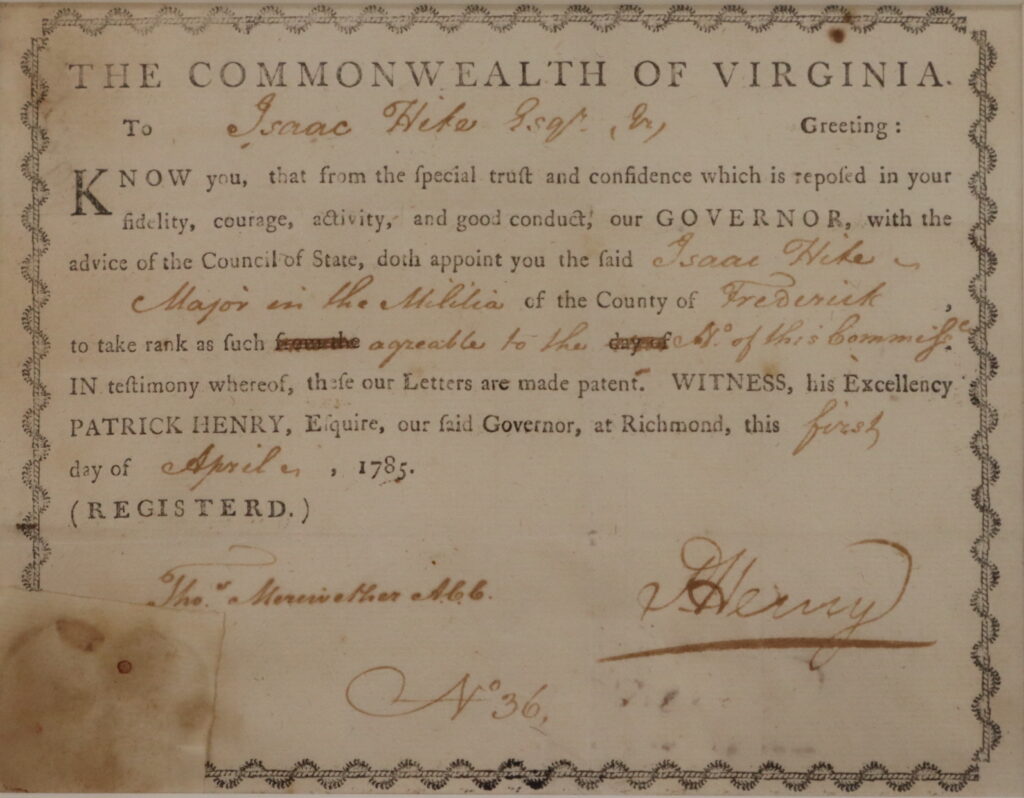
Signed by Patrick Henry, 1785
In 1785, after his discharge from the Continental Army, Virginia Governor Patrick Henry appointed Isaac Hite Jr. as Major of the Frederick County militia.
During peace time, militia rank was essentially an honorary title. Nevertheless, it was by the title of Major that he was known for the rest of his life.
Isaac Starts a Family
Historians are unsure when or where Isaac met his first wife, Eleanor (“Nelly”) Conway Madison, but he courted her at Montpelier following the war. Nelly was the daughter of James Madison Sr. and Nelly Conway, who lived across the Blue Ridge from the Shenandoah Valley. She was also the sister of James Madison Jr., the future president of the United States.
They married at Nelly’s family home in Orange County, Virginia on January 2, 1783.
Reverend Walker Maury married Isaac and Nelly on January 2, 1783 at Nelly’s family home in Orange County, Virginia. After their wedding, the couple returned to the Shenandoah Valley and took up residence on 483 acres that Isaac Hite Sr., Isaac’s father, had provided. Like her brother James, Nelly had been born at the plantation of her maternal grandmother and her grandmother’s second husband. That plantation stood on the Rappahannock River at Port Conway and was called Belle Grove. Isaac and Nelly gave the same name to their new home in the Shenandoah Valley.
Isaac and Nelly had three children. James Madison Hite was born in 1788 and died at the age of three. Nelly Conway Hite was born in 1789 and later married Dr. Cornelius Baldwin. In 1793, they had a third child who they also named James Madison Hite, but everyone called him “Madison.” He later married Caroline M. Irvine and lived at Guilford, his plantation in Clarke County, Virginia.
Nelly on Christmas Eve in 1802 at the age of 42. Most of Isaac’s surviving letters concern business, but a letter to his close friend and brother-in-law, Jonathan Clark, reveals his grief:
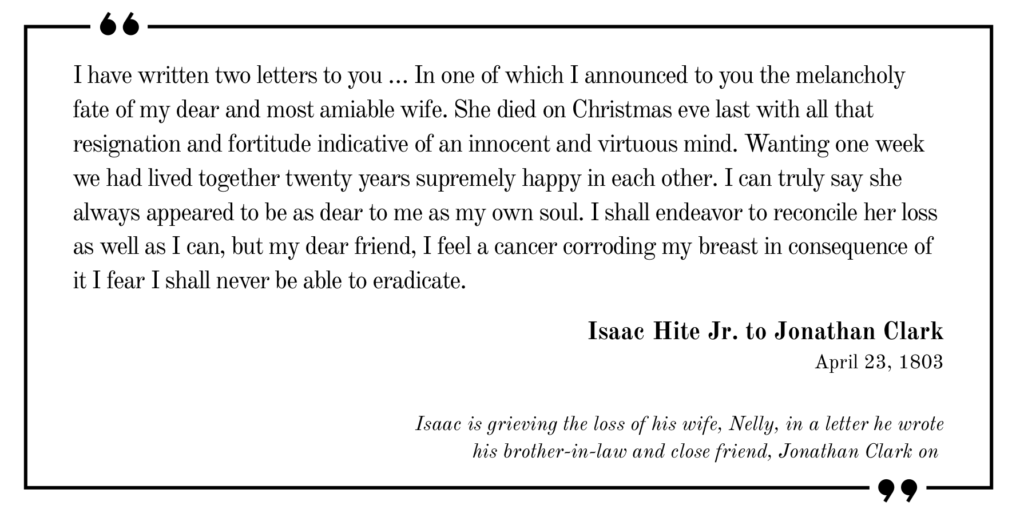
Nearly a year after Nelly’s death, Isaac remarried a young woman named Ann Tunstall Maury, daughter of Reverend Walker Maury (the same man who married him and Nelly!).
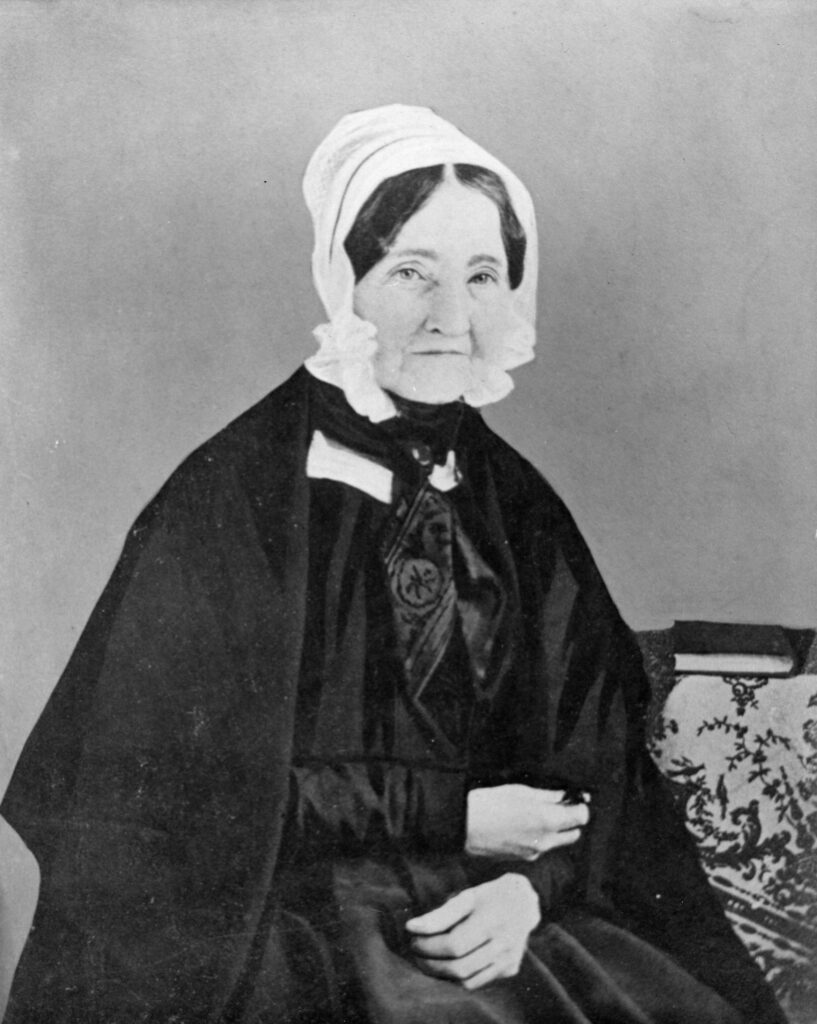
Ann’s widowed mother, Mary Grymes Maury, later moved to Belle Grove and lived there for the rest of her life. Between 1805 and 1819, Isaac and Ann had ten children, all of whom lived to adulthood: Ann Maury, Isaac Fontaine, Mary Eltinge, Rebecca Grymes, Walker Maury, Sarah Clark, Penelope Elizabeth Lee, Hugh Holmes, Cornelius Baldwin, and Matilda Madison.
Deteriorating Health & Death
Isaac suffered frequent severe headaches as early as 1799. By the mid-1820s, his wife Ann’s letters almost always mentioned his health, especially his “excruciating” headaches. He tried several treatments, including laudanum, a mixture of opium and alcohol widely used in the 18th and 19th centuries. He also tried bleeding and even putting salt on his feet. Mineral springs may have brought some relief; Ann’s letters mention two trips to Capon Springs and a visit to a sulfur spring near Madison Hite’s home.
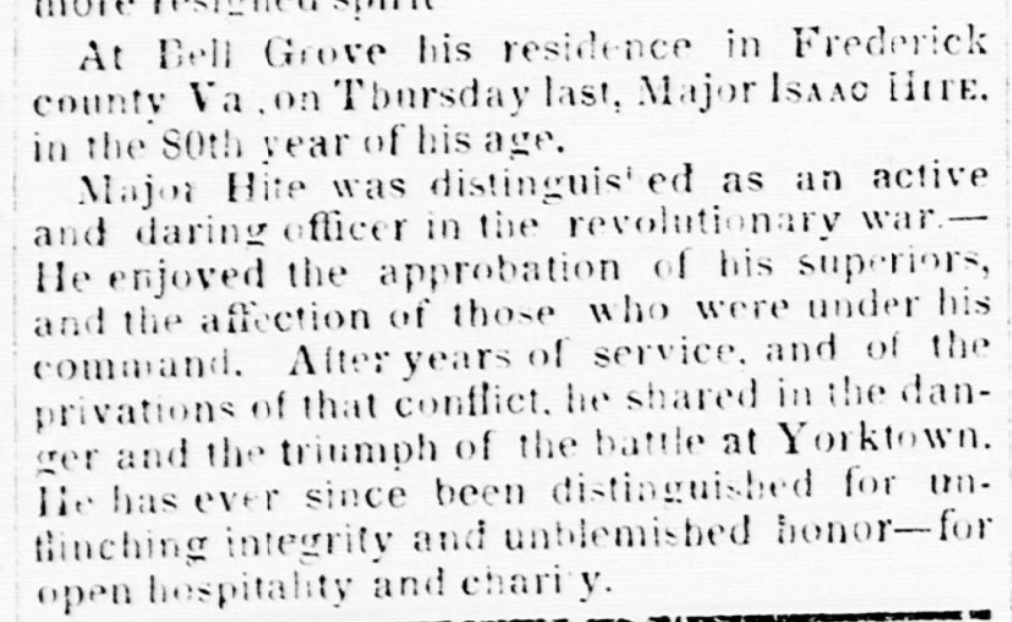
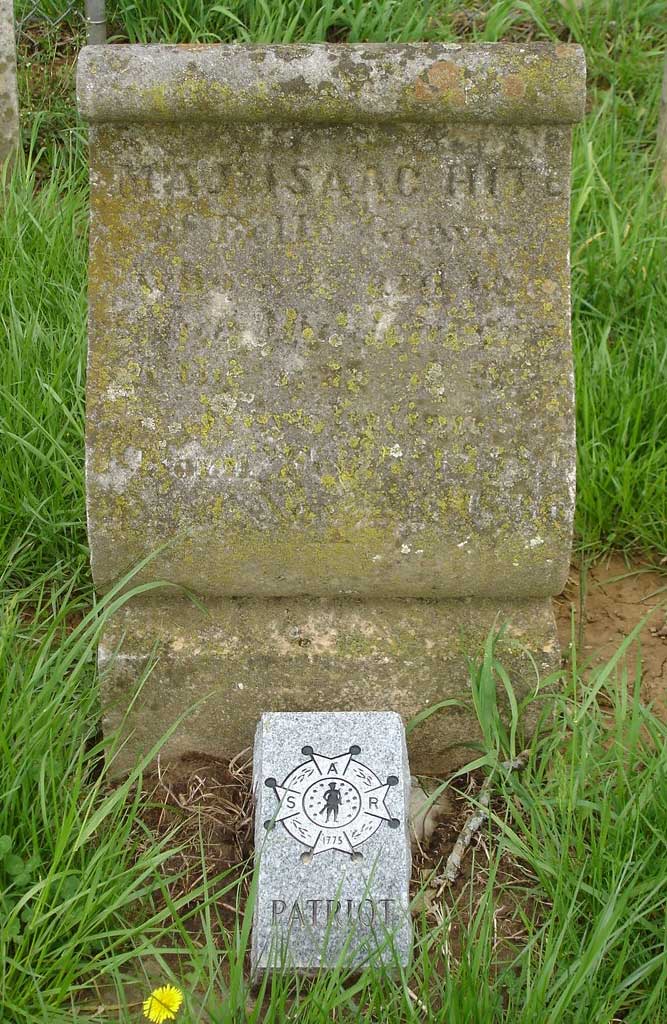
Isaac Hite died on November 24, 1836, at the age of 78. He was buried in the family cemetery at Long Meadow, where he had been born and raised. His wives, Nelly Madison Hite and Ann Maury Hite, were also buried there.
The Hypocrisy of “Freedom”

Isaac came home from war after fighting for freedom and helping America gain its independence from the British Crown, but the wealth he gained in the years following the revolution was in large part a result of the nearly 300 Black men, women, and children he enslaved.
Before Isaac Hite Jr. and Nelly Conway Madison married, their fathers arranged to provide the couple with land and the people expected to work it. In December 1782, Isaac Sr. wrote to James Madison Sr.,
[U]pon marriage I shall make him a Title for a Tract of Land of about Five hundred acres … Negroes I flatter my self it will be convenient for you to furnish.
Isaac Hite Sr. to James Madison Sr.
Nelly’s father provided 15 enslaved people—six adults and nine children. The record identifies them as “Jemmy, Jerry, Eliza, and her five children, to wit Joanna, Diana, Demas, Pendar, and Webster; also Truelove and her four children to wit, Peggy, Priscilla, Henry, and Katey; also Sally and Milley”. Their names and family relationships show how enslaved people were transferred as property within marriage and family arrangements.
The enslaved population grew rapidly. By 1810, more than 100 enslaved people lived at Belle Grove, including people owned by Ann’s mother and people too old or too young to work. That year, Belle Grove had the fourth-largest enslaved population in Frederick County.
To learn more about the enslaved community at Belle Grove Plantation, please visit some of our other exhibits:
Pause to Ponder
In 1785, Isaac wrote a lengthy transcription from John Locke’s Second Treatise, focusing on war, marriage, parental power, and slavery.
Was it perhaps the idealism of his youth?

Painted by Charles Peale Polk | Credit Belle Grove Plantation
Credit Belle Grove Plantation